
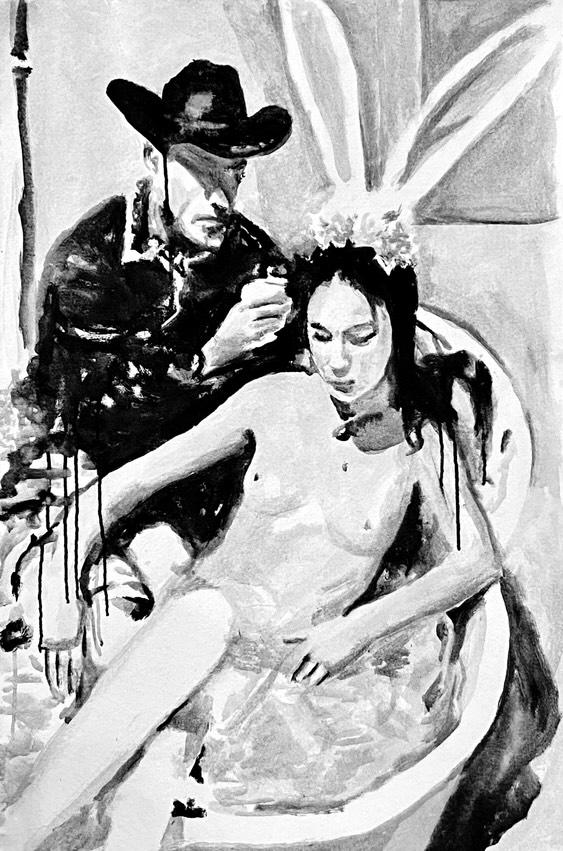
Rikki Kasso’s practice explores the movement of images between different places, cultures, and media. Born in New York in 1979, Kasso lived in Tokyo for approximately nine years before establishing his base in Australia. His experience across these different environments has shaped a visual language that moves freely between photography, painting, film, drawing, and installation.
Kasso’s work often begins with familiar subjects—bodies, landscapes, the sea, plants, light, and everyday scenes—but transforms them through shifts in perspective and medium. An image may begin as a photograph, emerge from memory, or come from direct observation, before being translated into painting or another form. Through this process, the original context becomes less certain, creating a space between reality, memory, and imagination.
This movement between contexts is central to Kasso’s practice. He is interested in how an image changes when it is removed from its original environment and placed somewhere else. A landscape becomes a memory; a body becomes part of the landscape; a photographic moment becomes something more ambiguous through paint and gesture.
Kasso’s years in Japan also played an important role in the development of his visual language. During his time in Tokyo, he developed an interest in Sumi ink and traditional brush techniques, incorporating their fluidity, gesture, and use of empty space into a broader approach to painting. Rather than simply combining Eastern and Western traditions, he reinterprets them through his own experience.
His work can therefore be understood not as belonging to a single cultural or artistic category, but as existing between them. Photography and painting, reality and fiction, nature and the body, observation and memory continually overlap.
Kasso’s recurring interest in isolation is also connected to this idea of separation. By taking an image or subject out of its familiar context, he creates the distance necessary for it to be seen anew.
For Kasso, painting is not simply a way of reproducing the world. It is a process of moving images from one context to another, allowing their meaning to change along the way. His work captures this continual movement, creating images that remain suspended between what is familiar and what is imagined.