
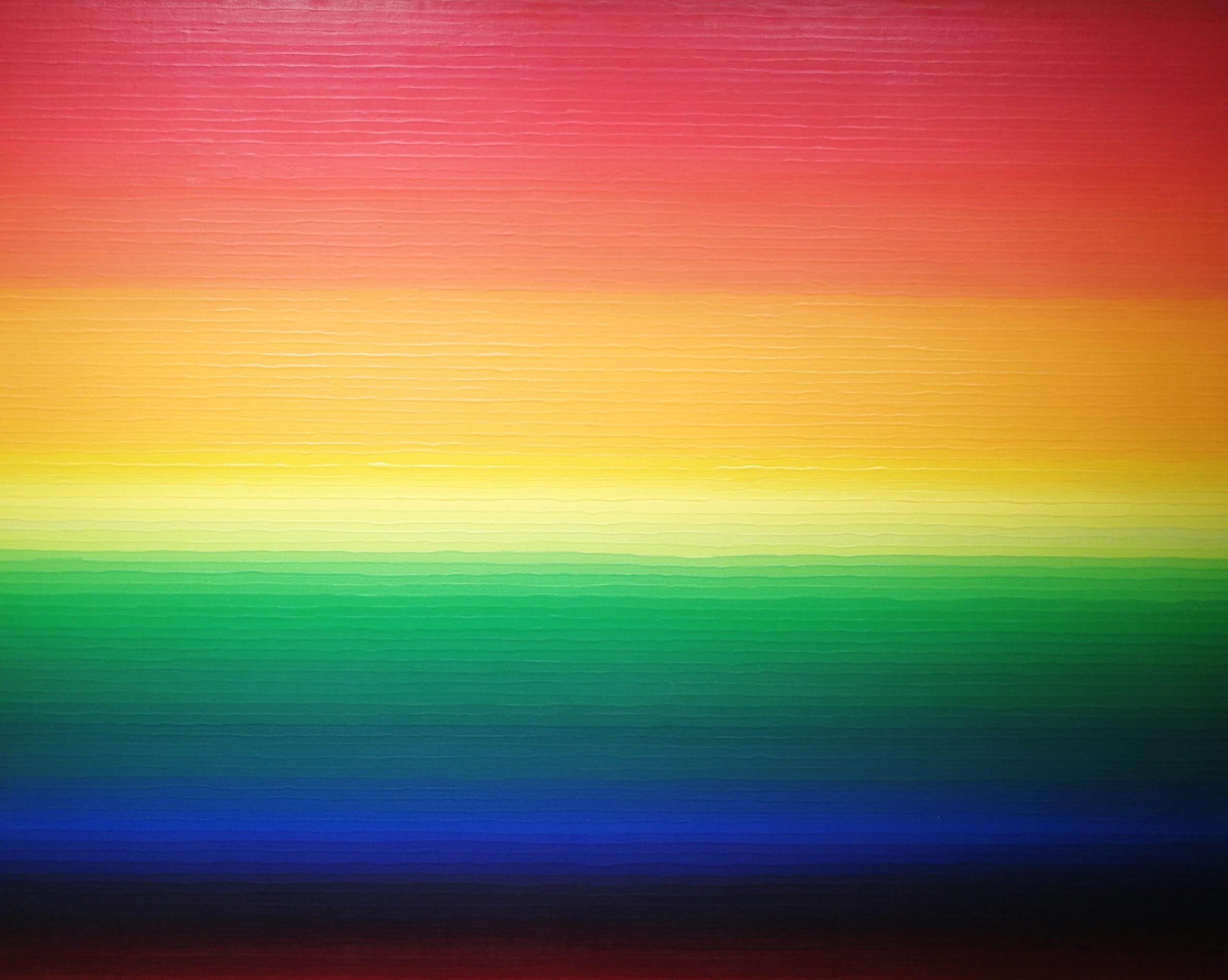
Ay-O (b. 1931) is a Japanese avant-garde artist whose practice has developed across painting, printmaking, sculpture, performance, and installation. Emerging from the postwar Japanese avant-garde, Ay-O moved to New York in 1958, where he became closely associated with the international Fluxus movement and artists including George Maciunas, Nam June Paik, and Yoko Ono.
From the 1960s onward, Ay-O explored ways of extending art beyond the conventional boundaries of the autonomous artwork. His practice embraces participation, chance, humor, and sensory experience, often inviting the viewer to engage with a work through the body rather than through vision alone. Works such as the Finger Box transform the act of looking into a tactile encounter, questioning the assumption that art is primarily a visual experience.
Color gradually became central to Ay-O’s practice. From the mid-1960s, the rainbow emerged as his defining visual language. Rather than functioning simply as a recurring motif, the spectrum became a systematic way of reorganizing the visible world. Everyday objects, figures, landscapes, animals, and historical imagery are transformed through sequences of intense color, allowing familiar subjects to appear at once recognizable and estranged.
The rainbow also reflects Ay-O’s broader interest in universality and perception. By treating color as a continuous spectrum rather than as isolated forms, he developed an image-world that could move across cultural and geographic boundaries. His participation in the 1966 Venice Biennale and his subsequent international recognition established his position within the wider history of postwar experimental art, while the name “Rainbow Man” came to embody the distinctive character of his practice.
Yet Ay-O’s work cannot be reduced to its vivid chromatic appearance. Behind the exuberance of his colors lies a sustained engagement with the principles of Fluxus: the dissolution of boundaries between art and everyday life, the activation of the viewer, and the possibility of transforming ordinary experience through unexpected encounters.
Situated between the Japanese avant-garde and the international experimental art of the 1960s, Ay-O’s practice offers a distinctive approach to color, perception, and participation. His rainbow is not merely an image, but a visual and conceptual system through which the familiar world can be continuously reimagined.